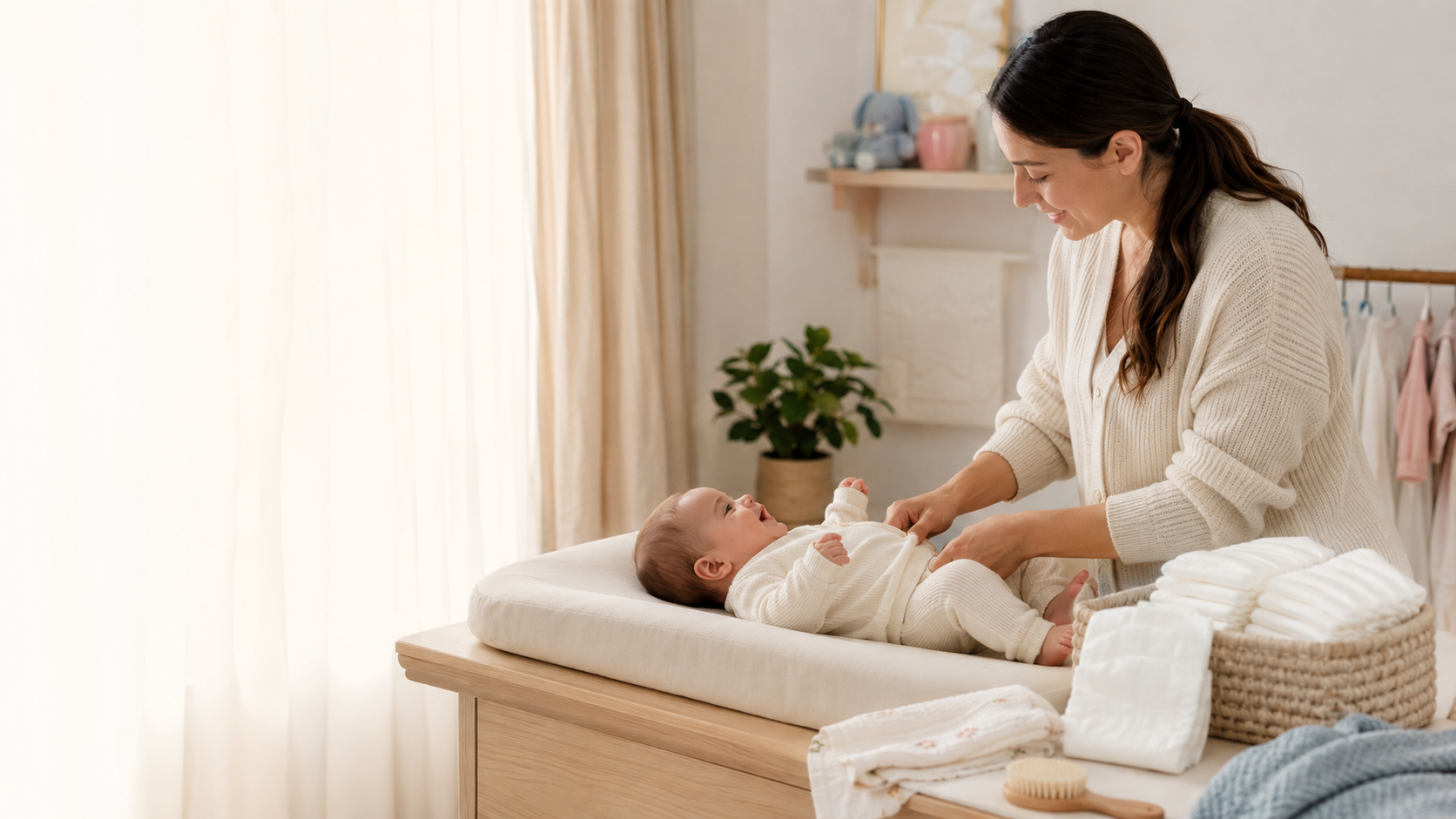
It is the fourth diaper change since lunch. You pull three wipes out of the pack, then a fourth, and the plastic lid clicks shut on a packet that was full on Tuesday. Somewhere at the back of your mind you are running a number: how many of these have you bought this month, and is that normal, and is there a version of this that does not involve buying a small plastic brick every week.
There is, and it is old and dull and works. It is a stack of cloth squares and some water. The real question is not whether reusable wipes clean a baby, because they do. It is whether the laundry fits into your life.
Here is the answer, and then the reasoning. Reusable wipes make sense if you are already washing cloth diapers, or if most of your changes happen at home and you do a load of laundry most days anyway. They do not make sense as a standalone project if your washing machine is already the bottleneck in your week. And almost nobody who tries them goes all the way: the arrangement that survives is cloth at home, disposable in the bag.
The short answer
| If this is you | Do this |
|---|---|
| Already using cloth diapers | Use cloth wipes. The wipes go in the same wash as the diapers, so they cost you no extra loads at all. This is the strongest case there is. |
| Disposable diapers, mostly home, laundry runs most days | Worth trying. Start with two dozen wipes and water only, and give it three weeks before deciding. |
| Out of the house a lot, or laundry is already a struggle | Stay disposable, without guilt. A system you cannot keep up with is worse than the one you have. |
| Shared or coin laundry | Stay disposable at home too. The arithmetic stops working when a load has a price. |
If you are still deciding on the diapers themselves, that is a separate and bigger question, and it is answered in cloth diapers vs disposable.
What reusable wipes actually are
Squares of cloth, usually around eight inches, in flannel, cotton terry or bamboo. That is the whole product. You wet them and you wash them.
- Warm water is enough for almost every change. You do not need a solution, and plain water is the gentlest thing you can put on a newborn’s skin.
- Two ways to wet them. Either keep them dry in a stack and run one under the tap as you go, or pre-wet a day’s worth in a lidded container. Running the tap is more reliable; pre-wetting is faster at three in the morning.
- A spray bottle is the third option, and it is the one that travels best: dry wipes in a pouch, water in a small bottle, spray the wipe when you need it.
- You need more than you think. Two dozen is a starting stack. Three dozen if you want to skip a laundry day without running out.
You can also cut up old flannel receiving blankets or a worn towel and hem the edges, which costs nothing and works as well as anything sold for the purpose. The bought ones are softer and the edges do not fray, and that is the difference.
The cost, done properly
Most comparisons quote a saving and skip the working. Do it yourself in two minutes with your own numbers, because the answer depends entirely on how many changes you do and what you currently pay.
- Count your changes. A newborn is commonly eight to twelve a day. By a year it is more like five or six.
- Count wipes per change. One or two for a wet diaper, four to six for the other kind. Call it three on average and you will not be far off.
- Multiply out a month, then check it against how many packs you actually bought last month. People routinely underestimate this by half.
- Against that, put the one-off cost of the cloth and the running cost of the extra laundry.
Two caveats on the saving, and both are real. First, if the wipes ride along with a cloth diaper wash you were doing anyway, the running cost is close to zero and the saving is large. Second, if reusable wipes mean an extra load two or three times a week that you would not otherwise run, water, power and detergent eat a real share of the difference. That does not make it pointless, it makes it smaller than the number on the box.
The laundry is the real cost, and it is not money
This is what decides it, and it is why the answer is different for two families paying identical prices.
The routine that works: a lidded pail or a wet bag beside the changing table, used wipes go straight in, and the whole thing goes in the machine every two or three days. Solid waste gets knocked into the toilet first, exactly as with cloth diapers. Wash warm with a fragrance free detergent, tumble or line dry. No softener, ever, because it coats the fibers and a coated wipe stops absorbing.
Three practical points that make the difference between keeping this up and quitting in week two:
- Do not let the pail go past three days. Past that it smells, and the smell is what makes people give up.
- Wash them with the diapers if you have them, or with towels if you do not. A load of two dozen small cloths on its own is a waste of a cycle.
- Have a second stack ready. Running out mid-change, with a baby on the mat, is how the pack of disposables comes back out of the cupboard permanently.
What actually goes wrong
- Homemade solutions going off. The recipes circulating with oil, soap and a splash of something in a warm tub of water are a good place for bacteria and mold to grow. If you make a solution, mix small amounts, keep it no more than a day or two, and wash the container between batches. Plain water avoids the problem entirely.
- Wipes disappearing into the diaper pail. If you use disposable diapers, a used cloth wipe rolled inside one goes in the trash and is gone. Put the wet bag somewhere you cannot miss it, on the same side as your dominant hand.
- Essential oils. Skip them. They are a common irritant, they are unnecessary, and a newborn’s skin is not the place to experiment.
- Cold water in winter. A cold wet cloth wakes a settled baby instantly. A small thermos or a warmer beside the mat solves it, and it is the single upgrade most worth making.
- Using them on the face too. Fine, and quite sensible, but keep those in a separate stack and separate colour. You will be glad of the distinction.
The split most people land on
Cloth at home, disposable in the diaper bag. It is not a compromise made out of weakness, it is the arrangement that survives contact with a real week.
At home you have a tap, a pail and a machine, so cloth costs you almost nothing. Out of the house you have none of those, and carrying a bag of used wet cloths around a supermarket for three hours is the part nobody enjoys. Roughly seventy to eighty per cent of changes in the first year happen at home for most families, so a home-only switch captures most of the benefit for a fraction of the friction.
Buy one pack of disposables for the bag, keep it in the bag, and stop thinking about it. What goes in that bag otherwise is covered in the diaper guide.
If you stay disposable, two things worth knowing
Staying disposable is a completely reasonable decision and most families make it. Two things are worth knowing anyway.
- Do not flush them, including the ones labelled flushable. Baby wipes do not break apart in water the way toilet paper does. They pass the toilet and then collect in the pipe, and water utilities across the country spend a great deal of money pulling them out of pumps and sewers. Flushable on the packet means it will go down, not that it will disappear. Put a small lidded bin beside the toilet and use it.
- Read the ingredient panel once. Fragrance is the most common irritant, and the alcohol in some formulations stings broken skin. If your baby is red and sore, switching to a fragrance free wipe, or to plain water on cloth for a few days, is the cheapest thing to try before you buy a cream.
And whichever you use, the technique matters more than the material: front to back, gently, into the creases, and let the skin dry properly before the next diaper goes on. That last part prevents more rashes than any product does. The full method is in how to change a diaper.
Medical disclaimer: This article is for general educational purposes only and is not medical advice. If your baby has a diaper rash that is spreading, blistering, bleeding, not improving after a few days, or coming with a fever, speak to your pediatrician rather than changing products again.
Sources
- American Academy of Pediatrics, HealthyChildren.org. “Diaper Rash: Prevention and Treatment.” 2024.
- U.S. Environmental Protection Agency. “What Not to Flush: Wipes Clog Pipes.”
- National Association of Clean Water Agencies. “Wipes in the Wastewater System.”
Did this help?
If it did, tap Yes below. It is the only thank-you we ask for, and it tells us what to write more of.
Thank you so much, that genuinely helps and means a lot.
Thanks for the honesty. Tell us what was missing and we will make it better.

From other parents