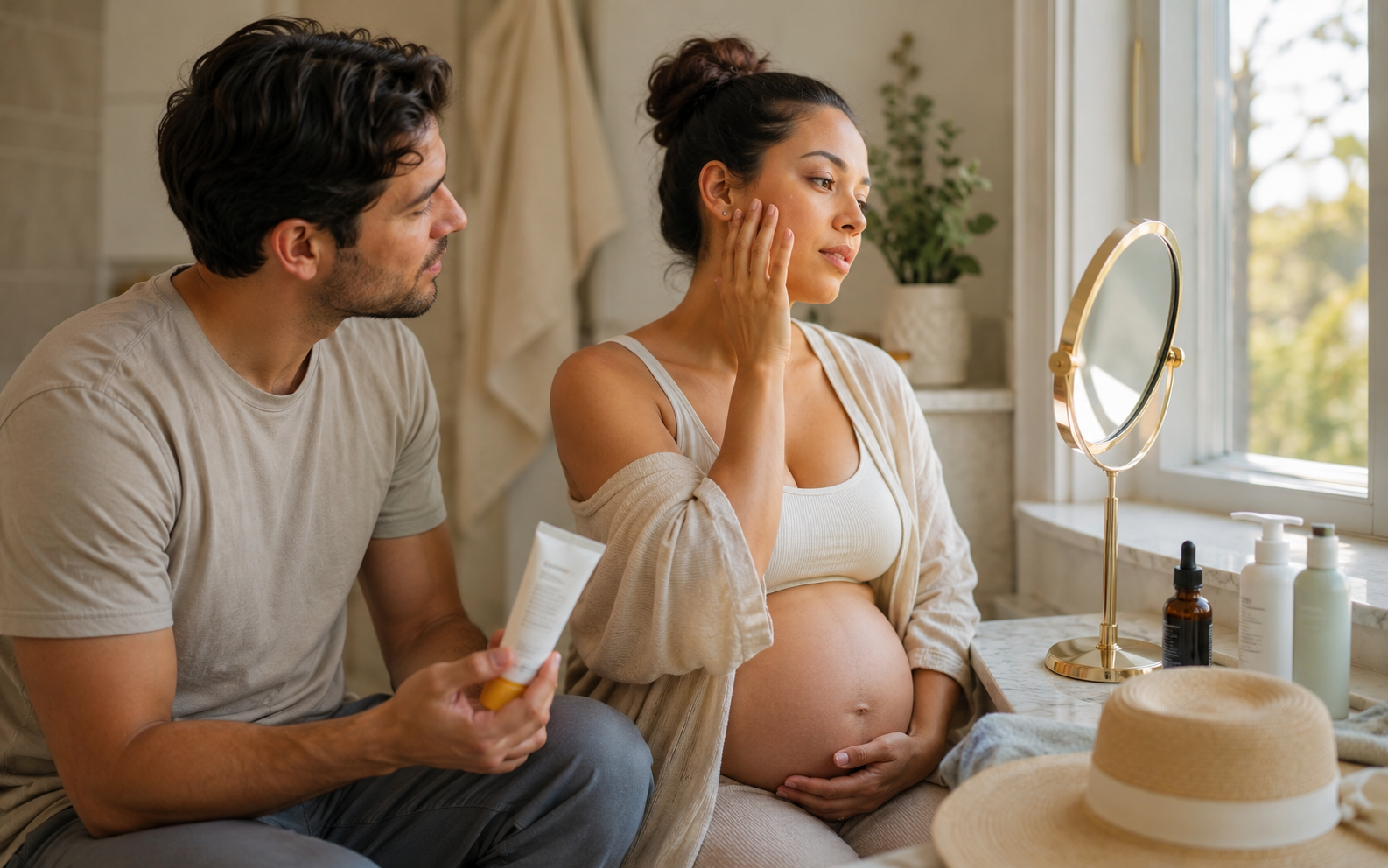
If you have noticed new brown patches creeping across your cheeks, or a dark line tracing down the middle of your belly, you are not doing anything wrong, and your skin is not damaged. These changes are one of the most common things that happen during pregnancy, and for most people they are completely harmless.
This shift in pigment even has a nickname: the mask of pregnancy. It can feel surprising the first time you spot it in the mirror, especially when no one warned you. So let us walk through what is happening, why it happens, and the gentle, realistic things you can do about it right now.
- Melasma (the mask of pregnancy or chloasma) is brown or grey-brown patches, usually on the face, caused by pregnancy hormones plus sun exposure.
- The linea nigra, that dark line down your belly, is the same kind of harmless pigment change.
- It is very common, not a sign of anything wrong, and often fades in the months after birth, though not always.
- Daily mineral SPF, sun avoidance, and gentle skincare are your best tools right now.
- Stronger treatments like hydroquinone and retinoids are usually saved for after pregnancy or breastfeeding.
What melasma actually is
Melasma shows up as flat brown or grey-brown patches, most often across the cheeks, forehead, upper lip, nose, and chin. The patches are usually symmetrical, which means they tend to mirror each other on both sides of your face. You might hear it called chloasma or, more poetically, the mask of pregnancy.
It is not a rash, and it does not hurt, itch, or peel. The skin simply produces extra pigment in certain spots. While it shows up most on the face, you can also notice darkening in other areas, including your underarms, inner thighs, and around your nipples. None of this is a problem for your health or your baby’s.
The linea nigra: the line down your belly
That dark vertical line running from your belly button down toward your pubic bone is called the linea nigra, which simply means black line. It was actually there all along as a faint, barely visible line called the linea alba. Pregnancy hormones just turn up the pigment so it becomes much more noticeable.
It is the exact same kind of harmless pigment change as facial melasma, just in a different spot. You do not need to do anything about it, and for most people it gradually fades on its own in the months after birth.
Why it happens
Two things team up here. First, the surge of pregnancy hormones, especially estrogen and progesterone, signals the cells in your skin that make pigment to ramp up production. Second, sunlight nudges those same cells into overdrive. So the combination of shifting hormones and UV exposure is what creates and deepens the patches.
This is why sun protection matters so much. Even short, everyday exposure, like the drive to work or a walk to the mailbox, can make existing patches darker. Genetics and skin tone also play a role, and people with medium to deeper skin tones are more likely to experience it. If it runs in your family, you may be more prone to it too.
Will it go away?
Here is the reassuring part. For many people, melasma and the linea nigra fade significantly in the months after the baby arrives, as hormone levels settle back down. You may notice the patches lighten gradually over weeks and months rather than disappearing overnight.
That said, it does not always vanish completely, and that is okay too. Some people keep faint traces, and sun exposure can bring patches back or make lingering ones more stubborn. Being patient with your skin and consistent with sun protection gives you the best shot at it fading well.
What you can do right now
You cannot control your hormones, but you can absolutely take the sun out of the equation as much as possible. This is the single most effective thing you can do while pregnant.
- Wear mineral SPF every single day. A broad-spectrum mineral sunscreen with zinc oxide or titanium dioxide is a gentle, pregnancy-friendly choice. Reapply through the day, even when it is cloudy. Our guide to pregnancy-safe sunscreen walks through what to look for.
- Add shade and a hat. A wide-brimmed hat, sunglasses, and seeking shade during peak midday hours all help reduce the UV that triggers pigment.
- Keep skincare gentle. Harsh scrubs and irritating products can actually make melasma worse by inflaming the skin. Stick to a simple, kind routine. See our overview of pregnancy-safe skincare for ideas.
- Choose pregnancy-friendly brightening ingredients. Vitamin C, niacinamide, and azelaic acid are generally considered safe to use during pregnancy and can gently help with tone over time.
For a fuller list of what is generally fine versus what to skip for now, our roundup of pregnancy-safe ingredients is a handy reference.
Treatments usually saved for later
Some of the most well-known melasma treatments are typically put on pause during pregnancy and breastfeeding. Hydroquinone, a common skin-lightening ingredient, and retinoids, the vitamin A derivatives found in many anti-aging products, are generally avoided until after this season of life.
There is no need to feel rushed. Waiting until after pregnancy or breastfeeding to consider stronger options is completely reasonable, and for now gentle care and sun protection are doing real work. Always check any product or treatment with your own provider before starting it.
When to see a dermatologist
Melasma itself is harmless, so you do not need to see anyone just because you have it. But it is worth booking a visit with a dermatologist if a patch looks different from the rest, such as a spot that is raised, changing in size or color, bleeding, or has irregular borders. Those features are not typical of melasma and deserve a closer look.
It is also reasonable to see a dermatologist if your melasma is bothering you emotionally, or if it has not faded after birth and you want to talk through a treatment plan once you are no longer pregnant or breastfeeding. A professional can tailor advice to your skin and your timeline.
Whatever your skin is doing right now, it is responding to the incredible work your body is putting in. These changes are common, temporary for most people, and nothing to be ashamed of. Slather on that SPF, and know that your skin is in good company.
Medical disclaimer: This article is for general educational purposes only and is not medical advice. It does not replace care from a doctor, midwife, or dermatologist. Always confirm treatments with a qualified professional. If you think you may be experiencing a medical emergency, contact your local emergency services right away.
Sources
- American Academy of Dermatology. “Melasma: Diagnosis and Treatment.” 2024.
- American College of Obstetricians and Gynecologists. “Skin Conditions During Pregnancy.” 2024.
- National Health Service (UK). “Common Skin Changes in Pregnancy.” 2024.
- Mayo Clinic. “Melasma: Symptoms and Causes.” 2024.
Did this help?
If it did, tap Yes below. It is the only thank-you we ask for, and it tells us what to write more of.
Thank you so much, that genuinely helps and means a lot.
Thanks for the honesty. Tell us what was missing and we will make it better.

From other parents