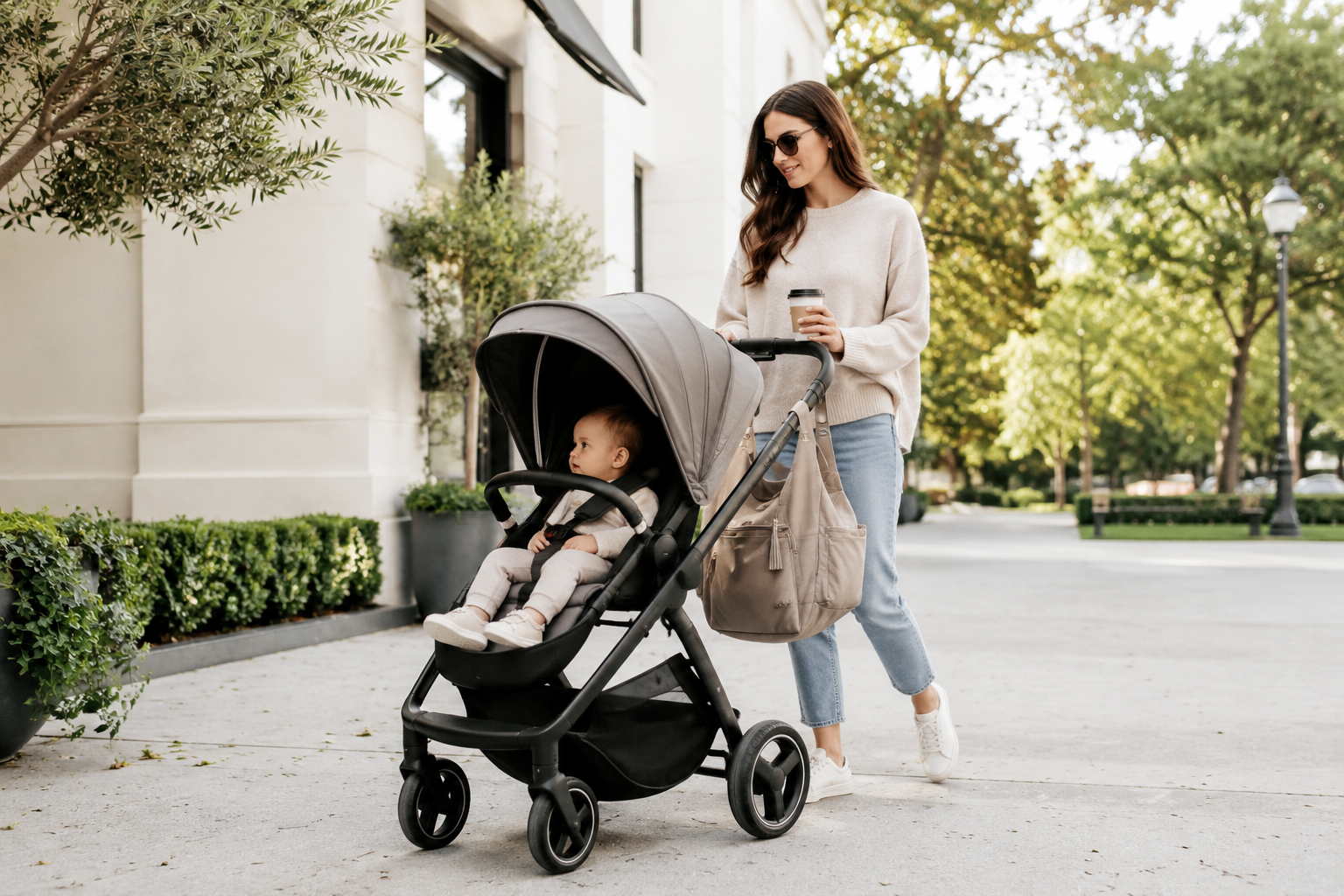
My two are ten years apart, so I never had to answer this one for myself. No newborn and toddler in the same house, no parking lot standoff, no double anything. What I got instead was stranger: shopping for baby gear a decade after I last did it, and finding how little had actually gotten easier. Thousands of options, glowing reviews on all of them, and almost nothing that just told you how to choose.
So this is the page I went looking for and could not find. If you are the one with the newborn asleep in the carrier and the two year old flat on her back beside the cart corral, refusing to walk, refusing to be carried, refusing everything, this is how I would work it out.
Here is the answer, and then the reasoning. Buy one if your children are under about three years apart and you walk or take transit most days. Do not, if the gap is over four years or you drive nearly everywhere. And before any of that, check whether the stroller already in your hallway turns into a double, because a lot of them do and almost nobody checks.
The thing worth knowing underneath all of it: a double stroller is not really about the baby. The baby is content almost anywhere. It is about your older child, who can walk, and frequently will not.
First, check whether the one you own already converts
This is the step that gets skipped, and for some families it ends the question before it starts. A large share of full-size single strollers are built to expand. The frame you already own may take a second seat, a bassinet, or a ride-along board, sold separately and usually for far less than a new stroller.
Look up your exact model and search for its name plus “second seat” or “double” or “expandable”. What you are looking for is an official accessory from the same brand, because a second seat has to be rated for that frame. Three things to check while you are there:
- Whether the second seat fits your baby’s age. Some attach only once the younger child can sit unsupported, which is no use at three months.
- The combined weight limit, and how close your older child already is to it. This is the one that quietly rules the option out for a heavier four year old.
- What it does to the folded size. A converted double folds bigger than the single did, and that is the whole reason people end up disappointed.
If you are still shopping for your first stroller and a second child is likely, buying a single that is designed to expand is usually cheaper over five years than buying a single now and a double later. You pay more once instead of twice.
Your kids’ age gap decides this more than anything else
Work out how old your older child will be when the baby is around six months, because that is when you start leaving the house properly again.
| Age gap | The call | Why |
|---|---|---|
| Under 2 years | Buy one | You will use it almost every day for a good two years. |
| 2 to 3 years | Usually yes | Daily at first, then two or three times a week. Worth it especially if you do not drive everywhere. |
| 3 to 4 years | Try a board first | The coin toss band. A stroller board solves it for most families here, for about a tenth of the money. |
| Over 4 years | Usually no | Your older one walks, scoots, and would rather not be strapped in next to a baby. |
The exception that overrides the table: if your older child has additional needs, tires quickly, or is a determined bolter near roads, the gap matters far less than the safety of having them contained. That is a real reason and it does not need justifying to anyone.
Three cheaper things to try first
A double stroller is one of the largest single purchases of the second baby, and there are three things that solve the same problem for a fraction of it. Try them before you commit.
- A stroller board. A platform that clips to the back of the stroller you already own, so your older one stands and rides. Works from about two and a half. This is the answer for most three-plus-year gaps, and it is the one people skip past because it feels too easy.
- A carrier for the baby, stroller for the toddler. Counterintuitive and very effective. The newborn is content strapped to you; the toddler is the one who needs the seat and the snack tray.
- Borrowing one for two weeks. Local parent groups are full of doubles gathering dust in garages. Two weeks of real use tells you more than any review, including this one.
When it is genuinely worth it
Buy one if two or more of these are true. Not one. Two.
- Your children are under three years apart.
- You walk, take the bus or train most days rather than driving.
- Your older child still naps out of the house, or falls asleep on the way home.
- You do the school or daycare run on foot with both children.
- You are outnumbered often, meaning one adult and two children with no second pair of hands.
The school run is the one that catches people out. A twenty minute walk twice a day with a toddler who dawdles is the difference between a double being an indulgence and a double being the reason you get anywhere on time.
When it is not
- You drive nearly everywhere. A double lives in the trunk and eats all of it. You will resent it at every shop.
- Your gap is over three and a half years. A stroller board, almost always.
- You want it for holidays and days out only. Hire one at the destination, or borrow.
- Your front door, hallway, or elevator is narrow. Measure before you fall in love with anything. A stroller you cannot get through your own door is a very expensive hallway ornament.
If you are buying, which type
There are two shapes and the choice is mostly about doorways.
| What matters | Tandem (one behind the other) | Side by side |
|---|---|---|
| Width | Same as a single, fits any doorway | Wider, and some store aisles are a problem |
| Length | Long, awkward on tight turns | Normal |
| Steering | Heavier at the front | Easier, more even |
| Children can see each other | Not really | Yes, for better and worse |
| Best for | Cities, narrow homes, public transport | Parks, sidewalks, wider doors |
| Converted single | A third option: cheaper than either if your frame takes a second seat, but heavier and bulkier folded than a purpose-built double. | |
If you live somewhere with narrow doorways or you ride the bus often, tandem. If you are mostly on sidewalks and in parks, side by side is easier to push and easier to live with. Our full picks and the trade-offs on each one are in the best strollers guide.
Measure these three things before you buy
Five minutes with a tape measure prevents the most common and most expensive mistake.
- Your narrowest doorway, usually the bathroom or the front door when it is not propped fully open.
- Your car trunk, width and depth, with the parcel shelf in.
- Your hallway or elevator, if you are in an apartment, and whether you can turn the corner at the bottom of the stairs.
Write those three numbers in your phone and check every stroller against them before you look at a single photograph. It sounds joyless. It is the difference between a purchase you use and a purchase you apologize for.
And if you are still on the fence after all that, borrow one for two weeks. Two weeks of real use settles it in one direction or the other, and it costs nothing.
Medical disclaimer: This article is for general educational purposes only and is not medical advice. If your child has additional needs, mobility differences, or a condition affecting how they sit or are positioned, speak to your pediatrician or physiotherapist about what is suitable before choosing a stroller.
Sources
- American Academy of Pediatrics, HealthyChildren.org. “Baby Carriers, Seats, and Strollers: Safety Tips.” 2024.
- U.S. Consumer Product Safety Commission. “Carriages and Strollers Business Guidance and Safety Standard.” 2024.
- Nationwide Children’s Hospital. “Stroller and Carrier Safety.” 2023.
Did this help?
If it did, tap Yes below. It is the only thank-you we ask for, and it tells us what to write more of.
Thank you so much, that genuinely helps and means a lot.
Thanks for the honesty. Tell us what was missing and we will make it better.

From other parents