As an Amazon Associate I earn from qualifying purchases. Full disclosure.
The first time you open a pack of ovulation test strips, the instructions can feel weirdly intimidating for something you pee on. Two lines, but only one counts? Test in the afternoon, not the morning? Don’t drink water? Take a breath. Once you understand the one thing these strips are measuring, the whole process clicks, and you will be reading them like a pro within a cycle.
Quick heads up: a couple of links below are affiliate links, so if you buy through them we may earn a small commission at no extra cost to you. We only point you to things we would actually use. Full disclosure here.
- Ovulation strips (OPKs) detect your LH surge, which means ovulation is coming in about 12 to 36 hours.
- The test line must be as dark as, or darker than, the control line to count as positive.
- Test once or twice a day, around the same time, usually early afternoon.
- A positive is your green light: your most fertile days are right now.
What the strips are actually measuring
Just before you ovulate, your body sends out a surge of luteinizing hormone (LH). OPKs detect that surge in your pee. So a positive does not mean you are ovulating this second, it means ovulation is likely on its way within roughly a day or so.
That heads-up is exactly what makes them useful. Since sperm can survive a few days, catching the surge early lets you time things so everything is in place when the egg arrives.
How to use them, step by step
- Figure out when to start. If your cycle is around 28 days, begin testing about day 10 or 11. Shorter cycle, start a little earlier.
- Pick a consistent time. Early to mid afternoon is often best, since LH tends to show up in urine later in the day.
- Go easy on fluids beforehand. Drinking a lot right before testing dilutes your pee and can hide a real surge.
- Dip or hold in the stream for the time the package says, then lay the strip flat.
- Read it in the window on the box, usually around 5 minutes. Reading too late can give a misleading result.
How to read the result
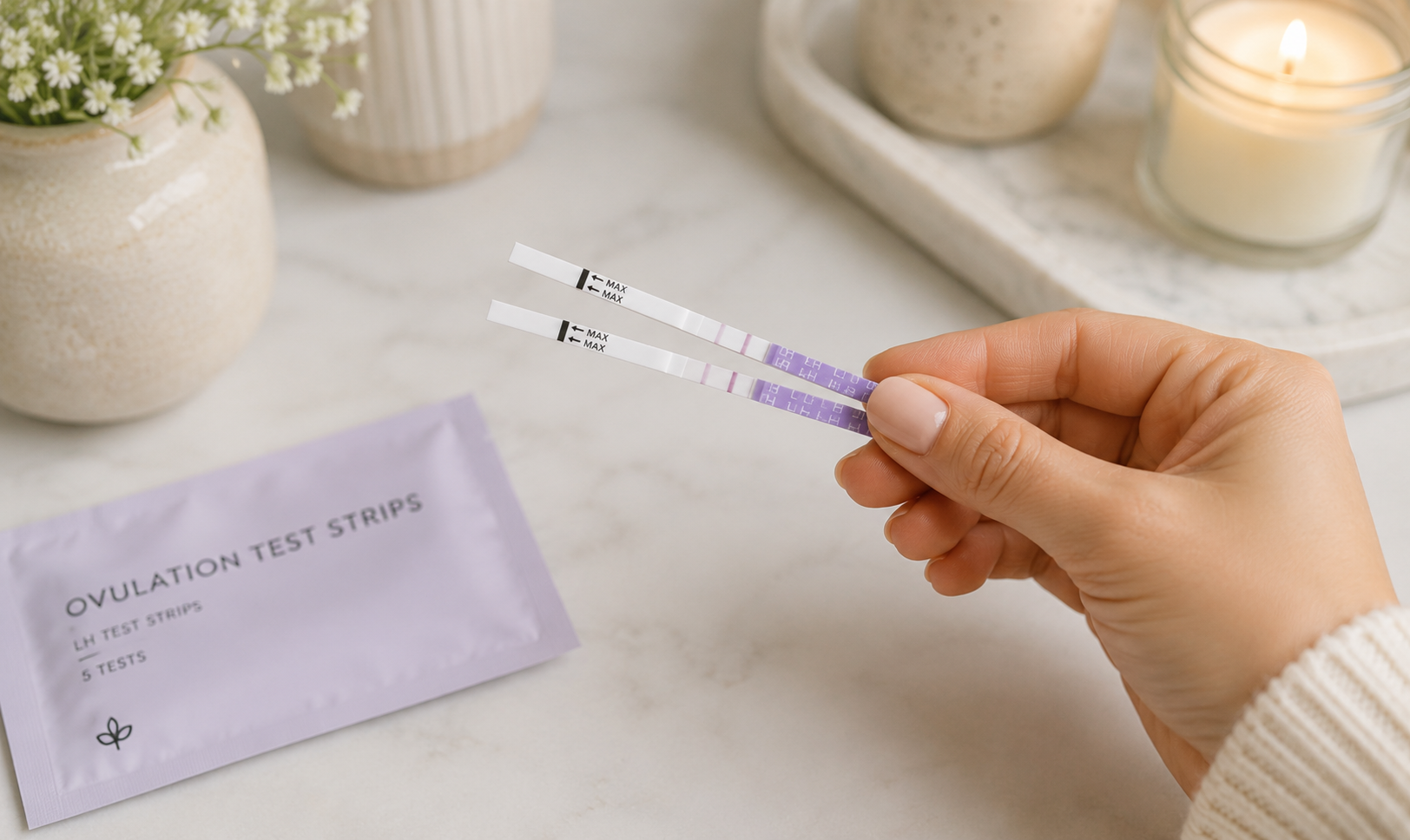
This is where most people get tripped up, so here is the rule that matters. Unlike a pregnancy test, any second line is not a yes.
| What you see | What it means |
|---|---|
| Test line lighter than the control line | Negative, your surge has not happened yet |
| Test line as dark as the control line | Positive, your surge is happening |
| Test line darker than the control line | Positive, definitely your surge |
| No control line at all | The test failed, retake it |
So a faint second line is still a negative. You are waiting for that test line to catch up to, or pass, the control line. Once it does, you have your answer.
What to do after a positive
A positive means ovulation is likely in the next 12 to 36 hours, so your best window is now and the next day or two. Once you get a clear positive, you can usually stop testing for the cycle. Digital strips that show a smiley face or “peak” reading take the guesswork out of reading lines, which some people find less stressful. View ovulation test strips on Amazon, or see our tested ovulation test picks.
Common things that throw people off
- You missed the surge. It can be short. Testing twice a day around the expected time helps you catch it.
- You keep getting positives. If you have PCOS, your LH can stay high all month and give false positives, so check with your doctor on the best approach.
- Never a clear positive. A few cycles with no peak is worth mentioning to a clinician.
- Reading wet or late. Read within the time window, not an hour later when the lines have shifted.
When to check in with a doctor
OPKs predict ovulation, they do not confirm it actually happened or diagnose anything. Reach out to a clinician if you never see a clear positive after a few cycles, if your cycles are very irregular or missing, or if you are under 35 and have been trying for about a year (or 35-plus and trying for around six months). For the bigger picture, see our guide on trying to conceive.
Medical disclaimer: This article is for general educational purposes only and is not medical advice. It does not replace care from a doctor, midwife, or fertility specialist. Always speak with a qualified healthcare professional about your cycle, fertility, or any health concern. If you think you may be experiencing a medical emergency, contact your local emergency services right away.
Sources
- National Institute of Child Health and Human Development. “How Do I Know If I’m Ovulating?” 2023.
- American College of Obstetricians and Gynecologists. “Fertility Awareness-Based Methods of Family Planning.” 2024.
- Office on Women’s Health, U.S. Department of Health and Human Services. “Trying to Conceive.” 2024.
Did this help?
If it did, tap Yes below. It is the only thank-you we ask for, and it tells us what to write more of.
Thank you so much, that genuinely helps and means a lot.
Thanks for the honesty. Tell us what was missing and we will make it better.

From other parents